PMS or Premenstrual Syndrome is part of every woman’s life. PMS occurs the week before menstruation and the different symptoms associated with PMS range from the emotional symptoms of PMS to the more physical symptoms.
Your PMS symptoms can change as you grow older, oftentimes they’ll become more intense as you age. But it’s important to note that PMS affects 90% of women, so you know you’re not alone.
What exactly is PMS?
Premenstrual Syndrome is a condition that affects menstruators the week before their period that can affect the body with physical symptoms such as cramps and headaches, as well as the mental health effects like anxiety, stress, irritability and gloominess.
When does PMS strike?
For most menstruators, PMS hits the body before their cycle, about 5-10 days before their period. PMS happens after ovulation and before the period.
There is no clear consensus, but some researchers believe that menstruators get their periods because estrogen and progesterone levels begin falling dramatically after ovulation. There are also changes in our brains that occur that cause PMS.
So is PMS really a brain thing?
Scientific studies show that, during PMS, women with severe PMS mood symptoms send much larger amounts of glucose to a specific area of the brain, the cerebellum. (1)
If there is not enough glucose (energy), the cerebellum can’t properly perform important functions like mood regulation, managing fear, pleasure responses and motor control. This leads to the four core mood symptoms of PMS: anxiety, gloominess, stress and irritability. You may have experienced these same mood alterations outside of PMS when you are hungry.
Your body is smart. Ravenous carb and fat cravings are the cerebellum yelling, “Give me more energy NOW!” This is why chocolate, chips and ice cream provide real short-term relief from PMS mood symptoms—and why adjusting hormones did not remove these cravings. (2) But because of the way we metabolically process sugar in these high carb foods, the short-term improvements are quickly lost as we sugar crash leaving the cerebellum with less energy (and more anxiety, gloominess, stress, and irritation) and making us feel worse than before. (3)
So What’s going on with my PMS?
Two neurotransmitters, GABA and glutamate, are always in a balancing act in the brain. During most of the month, the GABA/Glutamate ratio in your brain is level and keeps you feeling normal, but before your period hormonal shifts can knock them off balance. (4)
When glutamate levels are too high and GABA levels are too low, something that normally wouldn’t bother you feels like the world is crashing down on your shoulders. Excessive glutamate putting your brain on overdrive, every PMS symptom is exacerbated. (5)
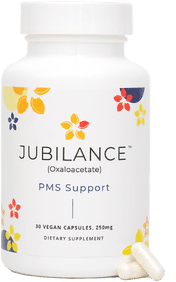
Jubilance (oxaloacetate/oaa supplement) mechanistically reduces excess glutamate levels, (6) and increases GABA levels (7) which may help you to feel like yourself again.
Jubilance has been shown to reduce excess glutamate levels, bringing your GABA and glutamate levels back into balance so you can feel like yourself again.
So how do I help my PMS?
Recent work suggests that an additional cause of PMS may be brain inflammation due to hormonal cycling. (78) Oxaloacetate has been shown to reduce the major inflammation pathway in the body, NF-kB, by up to 70% in animal models. (7)
The ability of oxaloacetate to decrease brain inflammation may be tied to the immediate relief some women feel with Jubilance, the oxaloacetate supplement for PMS.
This PMS Support Supplement helps with the highs and lows associated with your PMS mood swings. This supplement for mood swings has helped thousands of women to support the glutamate levels in their brain, so they can feel more like themselves. In less science-y speak, it’s helping regulate the sugar levels in your brain so you don’t feel all of the ups and downs.
Jubilance is the PMS Support Supplement you need to help with your PMS mood swings.
- Liu B, Wang G, Gao D, Gao F, Zhao B, Qiao M, et al. Alterations of GABA and glutamate-glutamine levels in premenstrual dysphoric disorder: a 3T proton magnetic resonance spectroscopy study. Psychiatry Res. 2015;231(1):64-70.
- Michener W, Rozin P, Freeman E, Gale L. The role of low progesterone and tension as triggers of perimenstrual chocolate and sweets craving: some negative experimental evidence. Physiol Behav. 1999;67(3):417-20.
- Mantantzis K, Schlaghecken F, Sunram-Lea SI, Maylor EA. Sugar rush or sugar crash? A meta-analysis of carbohydrate effects on mood. Neurosci Biobehav Rev. 2019;101:45-67.
- Bixo M, Ekberg K, Poromaa IS, Hirschberg AL, Jonasson AF, Andreen L, et al. Treatment of premenstrual dysphoric disorder with the GABAA receptor modulating steroid antagonist Sepranolone (UC1010)-A randomized controlled trial. Psychoneuroendocrinology. 2017;80:46-55.
- Femenia T, Gomez-Galan M, Lindskog M, Magara S. Dysfunctional hippocampal activity affects emotion and cognition in mood disorders. Brain Res. 2012;1476:58-70.
- Li Y, Hou X, Qi Q, Wang L, Luo L, Yang S, et al. Scavenging of blood glutamate for enhancing brain-to-blood glutamate efflux. Mol Med Rep. 2014;9(1):305-10.
- Wilkins HM, Harris JL, Carl SM, E L, Lu J, Eva Selfridge J, et al. Oxaloacetate activates brain mitochondrial biogenesis, enhances the insulin pathway, reduces inflammation and stimulates neurogenesis. Hum Mol Genet. 2014;23(24):6528-41.
- Bannister E. There is increasing evidence to suggest that brain inflammation could play a key role in the aetiology of psychiatric illness. Could inflammation be a cause of the premenstrual syndromes PMS and PMDD? Post Reprod Health. 2019;25(3):157-61.