
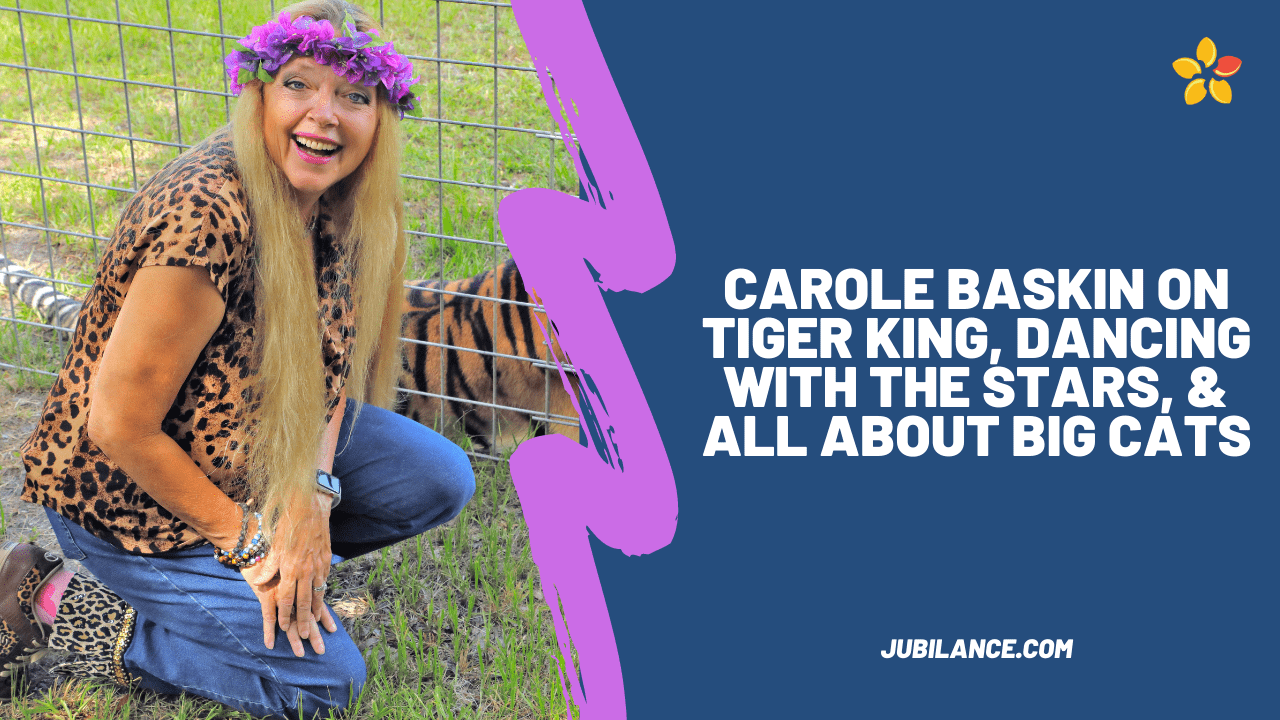
We’re talking to Carole Baskin who you might know from the Netflix documentary show, Tiger King, or her turn on Dancing With the Stars. We’re talking to her about life, big cats, and being portrayed on camera. This is an episode you don’t want to miss.
Watch her interview here:
Listen to her interview here:
Read her interview here:
Alice: Thank you so much. Okay. So today, we’re talking to Carole Baskin who you might know from the Netflix documentary show, Tiger King, or her turn on Dancing With the Stars. We’re talking to her about life, big cats, and being portrayed on camera. So, welcome Carole. We’re so excited to have you.
Carole Baskin: Hey, all you cool cats and kittens. Thank you for having me, Alice.
Alice: So I just wanted to ask first of all, what are you up to now that the world is starting to open back up and Florida is now completely open after the pandemic?
Carole: The sanctuary is still closed because even though the people here are vaccinated, the cats have not been vaccinated. And it’s my understanding there is now a vaccine available to the cats but the problem is, most of our population would be the equivalent of like a 90 to a 120 year old person. And so our vets, just not really sure, giving them that vaccine is going to be the safest thing for them. So, were kind of waiting on that. So we’re not open back to the public anymore.
Alice: Oh wow. That’s so interesting. Did any of your cats catch COVID? I know that cats are able to get it.
Carole: None of ours did, thankfully [crosstalk]. There were a number, in zoos and sanctuaries, that contracted the virus. And it’s the kind thing, well, it’s just like within people where it’s an upper respiratory distress, that would be really really dangerous to cats that are so old. There’s cats out there that are 25 years old, you multiply that by 6 and that’s what they be if they were human.
Alice: Oh good. Wow. And I hope you guys were all okay with COVID too?
Carole: Yeah. I don’t think anybody here actually contracted it. I’ve known an awful lot of people and I’ve had family members that contracted it, but nobody here at the sanctuary. Thankfully.
Alice: Okay, that’s good. And I wanted to start off with some more fun questions too. So I wanted to know, where do you get all of your clothing because it’s amazing? It all matches. It matches the sanctuary, your background is all leopard print, like that’s incredible. Where do you go shopping?
Carole: Well actually, I was going to ask the same of you because that is a tiger print shirt I have not seen anywhere before. It’s that a jacket?
Alice: It’s a jacket, yes. It’s a little hot but I was like, “I have to wear this.”
Carole: Well, to not to destroy the illusion here but this is shower curtains over my green screen. I’ve got to go[?] with that idea. And then you know, people know that I wear a lot of cat prints. And so every time somebody sees something in cat print, they send it to me which is result of in my closet being just over stuffed with cat prints. And then, when I was on Dancing with the Stars, there’s this company called Honeymay USA and they sent me a whole bushel basket full of these kind of shirts. I love them. They’re like these big long drippy, hides all your curves kind of thing and they’re all in cat prints, so I love them.
Alice: Oh, that’s amazing. Oh my gosh. And you also are iconically known for your flower crowns. Who makes those? Do you make those?
Carole: I have made some of them. This one was actually made by one of our online mavens, Deb Quimby. I thought she did a beautiful job of these flowers.
Alice: Oh my gosh, that’s gorgeous.
Carole: I bought several of them online, but the nice thing after Tiger King is, she can find them everywhere. Whereas, before Tiger King, they were really hard to find.
Alice: Yeah. You are an icon now. Like, everyone wants to wear a flower crown.
Carole: Maybe flowers are an icon.
Alice: Yeah. It is. It is uplifting right now during the pandemic.
Carole: Yeah, wear flowers on your head. I mean, what kind of world is this?
Alice: Yeah, totally. And you’ve had a number of different jobs throughout the years. One of my favorites has been, when you had a lawn mowing service with llamas, can you talk a little bit about that?
Carole: It’s funny how the press spends being that the llama lawn care business which was never a dream of it. But it could have been certainly. It actually came from the real estate investments that I do. So I had been investing in real estate since 1984 I think, and we would turn in, wherever we bought big tracts of land, we would turn llamas loose on those big properties. Because llamas are really easy to keep fenced-in. You could pretty much draw a line in the sand and say, “don’t cross that line,” they’re like “fine, we’re fine here.” Any other kind of animals just going to push right through a fence. And so that was how we actually ended up, at a auction, where we purchase the first bobcat that came here and started the sanctuary when [inaudible] was because we were there to buy llamas.
Alice: Amazing. That is so cool. Can you talk a little bit about Big Cat Rescue? What have you guys been doing during the pandemic? So you’re completely closed, are you still able to have volunteers to help with all the cats?
Carole: Yeah, and volunteers about is not just individuals like “hey, I’ll be [inaudible],” real vets. But as a result of COVID-19, we had to let go half of our paid staff, that we had about 20 paid staff at the time. So the people I had to let go of, were people who were managing things like donor appreciation or doing outreach to schools and things like that. So we just, you know, we’ve cut as many jobs as we could in order to keep taking care of the animals which is something we have to do no matter what. And we have to do fundraising, that sort of thing, to raise between 3 and a half or 4 million dollars a year to take care of those cats.
The fact that we have 80 to 120 volunteers at any given time and always have like since the 90s that numbers been consistent. It’s always somewhere between 80 and 120, and they do all of the animal care. So, they started showing up here around seven o’clock in the morning, and they go out and feed all of the cats, play novel, water bowls, clean all the food plates and then pick up all the feces and then they make all of the enrichment for the cats. So that the cats aren’t bored out of their minds. They’ve got something to tear up or something, you know, blood sickles, like, popsicles that are made out of frozen blood and it’ll [crosstalk]. Yeah, we do a lot of that everyday. Keep the cats entertained to keep them cooled off. And so thankfully, all of those things have continued without any detriment to the cats. But we’ve lost our revenues. So we close our gates on March the 15th and have not been able to reopen them, and that’s over a million dollars a year of our revenues.
So that’s why I was doing things like Dancing with the Stars and cameos and memos, and get close and personal, and all of those kinds of things to try and make up for that loss of income for the cats.
Alice: Wow. Wow, yeah. That’s a huge operation. I can’t even imagine like, how many pounds of food do you go through every day?
Carole: Our peak, we were going through 500 pounds of raw meat a day [crosstalk]. We had 200 cats and currently we have about 50. So we had a huge number of cats from the 90s from all of the Fur Farm Rescues that we did, where we rescue 56 cats, and then 28 cats, and then 22 cats. And then, you know, all of these other cats came in usually, and once in twos or maybe six at the time. But as they have aged out over the years, what we’ve discovered is, we can’t rescue our way out of it. So we’ve tried to focus on taking the best care we can of the animals that we have and we do some rescues, of course.
We still do bobcat rehab and release for native cats that are born in the wild. They’re the only ones legal to set free so we do a lot of that. We may have a new kitten coming in today. Yeah, they’re so precious. But I don’t know what the current food is right now. I’m guessing, because we have 50 cats, so it’s probably a quarter of that 500 pounds that we used to be today.
Alice: Wow. Wow, that’s unreal. That makes it really expensive and-
Carole: Yeah, it’s like prices of meat, like, you think of when you go to the grocery store because these cats need the whole animals. So whole crate, like whole rats and whole rabbits are so much more expensive than just buying that much in steak.
Alice: Wow, oh that’s interesting. Yeah, I wouldn’t think that they would need to eat everything.
Carole: Yeah. Sadly, their favorite thing is the brains. They just go for that first and so twice a week, they get whole free.
Alice: Oh my gosh. And what prompted you to start Big Cat Rescue?
Carole: You know, my passion was always to save domestic cats and kittens from dying in shelters due to overpopulation. But when I was 17, I started doing rehab and release for native bobcats. They get hit by a car, that can fix him up in 30 minutes but then you’re talking months of rehab for them to get ready to go back to the wild. And so, I started doing that when I was 17 and then I was like in 1992, I would have been 31 is when we rescued that bobcat that was being sold to a taxidermist, when we were there to buy llamas and that led us to the Fur Farm Rescues. And then people started calling and saying, “Would you check my lion? Would you check my tiger?” Like, what? “Did your mother know you were doing it?” That was crazy to me. And stupidly, I thought, “well, how hard could that be to fix,” right? But it’s taking us out 30 years, or finally closing in, on fixing it. But, yeah, that’s been a long hard slog.
Alice: Wow, that is amazing. That’s so interesting that you were able to go from bobcats to these bigger cats. And great, that you’re able to release the bobcats back into the wild. That’s amazing, the work that you’re able to do.
Carole: That’s the best part of our job is seeing them living the way they should live.
Alice: Wow, I was actually recently in Yosemite and I saw a bobcat in the wild for the first time in my whole life. Like, I’d seen them at the zoo because I’m from San Diego, but to see it in the wild and it was like trying to hunt, it was just amazing.
Carole: Wow. Oh! I’m so jealous. You know, I never see them in the wild unless they’re broken. And when people report to me that they’ve seen them doing their thing and being who they are, it’s like, “Oh! I love to see that.”
Alice: Yeah, it was pretty magical. I’ve never seen anything like it.
Carole: Yeah. It’s funny when you said, “wait, you go from bobcats to tigers.” There’s nothing that’s tougher than a bobcat, so if you can deal with one of them. Yeah, tigers are no problem.
Alice: Huh? Really, why?
Carole: I think it’s because tigers are at the top of the food chain and they don’t have to prove themselves everyday, whereas a 20-pound bobcat is always looking to make sure that everybody knows that they’re in charge. So they’re just much more challenging and in your face than a tiger or a lion.
Alice: Wow, that’s really interesting. I wouldn’t expect that. Yeah. And Carole, can you talk a little bit about going on Dancing with the Stars? I don’t think anyone can forget the Circle of Life or Eye of the Tiger, those were amazing. Your outfits were unreal, the sounds, the dancing. Can you talk a little bit about that?
Carole: When Tiger King came out, of course, the media was all over swimming to talk about it and I wasn’t willing to talk to anybody for a while. So I just put them all in a spreadsheet, I figured at some point, I would be able to deal with him. And my daughter looked at the sheet and she said, “you know, I really loved Jimmy Fallon and I love Dancing with the Stars, you should do that.” And I thought, “well, Dancing with the Stars sounds like,” because I’ve never seen it so I didn’t know how it worked. And I thought, “if I could get somebody who is a celebrity involved with me on this show, then maybe they could help us get the Big Cat Public Safety Act passed through congress,” because congress always wants to know what celebrities are working on this with you.
And so, I didn’t understand that I was supposed to be the celebrity because it never occurred to me till that point that anybody even thought of me in that way. And so they told me that I was going to have to learn how to dance and I’m like, “I’ve never danced a step in my life. There’s no way I can learn how to do this.” And so, they sent me those video clip of Cloris Leachman who was like 90 years old, I think, when she was on the show and they’re like it, “if she can do it, you can do it.” I was like, “yeah.” I was wrong, worst was I’m much more of an athlete when I was at 16.
Alice: I think you did a great job. I love seeing it. It was so fun. I like those amazing costumes, and just like getting up there, take so much confidence. I think that’s awesome.
Carole: You know, the costumes were my favorite part and the ladies who did the costumes came to me really timidly, and they were like, “we don’t want to offend you or set you but you know, we’d like to do some things that are a little bit different than we’ve ever done,” and I said, “as long as there’s no fur, feathers or leathers, then, you guys just knock yourself out. I don’t care what you do.” And they said they had more fun designing those costumes than they ever had. So it was fun to wear them and fun to see them enjoying being able to be so creative.
Alice: Oh, that’s amazing. And so, for everyone in our audience who hasn’t watched Carole’s take on Dancing with the Stars, you have to watch her Circle of Life dance which is so cool and she is dressed like a lion. It is so good. It’s just so fun. You’ll all love it and it’ll bring a smile to your face.
Carole: It took hours to do and my dance partner, Pasha Pashkov, he actually had like the whole nose built out, that he has took even longer and he couldn’t breathe. The whole time he was out there, he’s having to breathe through his mouth because that was just suffocating him and yet he still did such a great job.
Alice: Wow. That’s amazing. And did you choose the music for it?
Carole: What they had asked me at the beginning was all of my favorite songs, so I gave them a list of it, a dozen different songs and they chose everything after that.
Alice: Oh, awesome. It just fits so perfectly with you and like Big Cat Rescue. It’s awesome.
Carole: It was a lot of fun and the people there were so sweet. In fact, we’re doing a premiere in LA in August, for The Conservation Game, which is a film, we have gone for five years. Same five year period, we were working on the people that produced Tiger King. And so, we’re going out there to help them promote it and have already reached out to the woman who would asked me to be on Dancing With the Stars, her name is Leann [inaudible]. And so, we’ll be spending some time with her while we’re out in LA, because it’s just like family now.
Alice: Wow. Oh, that’s awesome. And can you talk a little bit about being on camera? So you’re on camera and this new documentary, that’s premiering as well as Dancing with the Stars and Tiger King. Can you talk a little bit about having cameras in your life, in your face?
Carole: I got really accustomed to having cameras rolling all the time, but it was usually me holding the camera for directing camera at the sanctuary because like I said, politicians always want celebrities to have their pictures made with and to show their constituents that they’re connected to celebrities. And so, I figured, you know, we’ll just make celebrities here because we weren’t able to attract the attention of anybody who was a celebrity. And so, I had a operations manager at that time, named Scott. And, he was this attractive guy, and really charismatic. And so, Animal Planet was running a contest for Animal Planet’s Hero of the Year award and we were voted him like crazy to be the Hero of the Year. We did all these videos of him at the sanctuary and on rescues and all that kind of stuff to promote that. And it became, just everyday out here, there were cameras, rolling on Scott, rolling on the volunteers. You’ll hardly ever find a picture or video of me anywhere here at the sanctuary because I’m usually, like I said, behind the camera. But, soon as he became the Animal Planet Hero of the Year, he decided he had a career in film and left. And so, I had to start over on our next operations manager.
And so, whenever film crews have reached out to us, we’ve always said, “Sure, come out. You are welcome to film.” We don’t charge them anything for doing that. Sometimes we worked with them for hours, sometimes days, sometimes years, like with the producers of Tiger King and the producers of The Conservation Game, and the producers of Hidden Tiger. Those were all being worked on simultaneously over a five-year period.
Alice: Wow.
Carole: So we were just accustomed to having cameras rolling on everything. And our vets are really good about it, too. Like we have live cameras all around the sanctuary that are on the cast 24/7, but we also have them in the Cat Hospital. So whenever they’re performing a surgery, the cameras are rolling and recording everything and we’re streaming it out to the public, live. And so, there’s a huge level of transparency here and just a sense that those cameras aren’t even there. I mean, we just don’t even hardly notice them anymore.
Alice: Yeah, that seems like a great way for the public to learn more about big cats and about veterinarian medicine in general. That’s interesting. And you were really the star of the show in Tiger King, can you talk about your portrayal? How did you feel about it going up on Netflix?
Carole: We were shocked because in all of the years that we have worked with filmmakers, we’ve never had filmmakers try to twist things into the false narrative that Tiger King was. And you know, even though the people that we go up against, these animal abusers and people that kill tigers, when they can’t use them anymore, they have said horrible things about me for decades. But the media, when they research it and they find it not to be true, they usually don’t expand on it. You know, they may say, “and Joe says she killed her husband,” but you know, they don’t try to make a big deal out of it because there’s no big deal to be made. And even though the producers of Tiger King had asked me all of those questions and I had given them all of the evidence, that should have made none of that important for their show. They just didn’t produce that evidence. And then instead allowed these people to just carry on, ad nauseam, about me without any kind of rebuttal.
So it really shocked me that people would see that and believe it, because I’ve dealt with them saying, those kinds of things before and nobody ever giving them any kind of credence or believing it. But it was masterfully done. If you go to bigcatrescue.org/Netflix, I’ve gone minute by minute through the video, especially that episode 3. When you’re seeing this on the screen, take notice of what you’re seeing versus what you’re hearing. And I had a guy that had actually done that yesterday that I was talking to, and he said, “yeah, and I felt so manipulated when I saw that.” Even though they were allowing him to say something about protecting cats or whatever, the whole time they’re showing you scowling into the camera or some slow motion, kind of a thing or, you know, having pieces of it interjected, that weren’t part of that actual conversation.
And it just, it was shocking to me that they would do such a horrible thing to me and to the sanctuary community. They really seem to have tried their best to paint sanctuaries and zoos as being the same, even though we’re polar opposites. Zoos are in the business of buying and breeding and selling. And some of them, there’s about six of them, where they pimped out the cubs for people to touch them. And it may take them off site for exhibits. Sanctuaries on the other hand, are barred from buying or selling or trading or allowing public contact or taking the animals off site for exhibition. And so, it just couldn’t be any different, yet, that’s not the opinion people came out of Tiger King believing, and that was sad. And I think the biggest loser in all of it was the tiger because at the end of Tiger King, it was like, and all of these people were just worried and there’s nothing we can do. And it’s like, “absolutely not.” There is so much we could do to end this views and to save the tiger before they do go extinct. And yet they didn’t put any of that in there.
Alice: Yeah, well thank you so much for talking about that. I know it’s difficult to see yourself on screen and thank you for sharing all of that. How do you continue to deal with the notoriety that Tiger King has given you? There’s the good and the bad, what advice would you give to others when they’re having a bad day or hearing terrible things about themselves? What do you do to keep positive?
Carole: I think I’m really fortunate in that, I believe that we are eternal and that we all decide or on the other side of the veil, what we’re going to do in the next life. And we all kind of jump in it together, we’re going to have the good guys and the bad guys and we’re all going to play our parts but the whole purpose of that is to lead us all, as a collective, to a higher sense of enlightenment. And so, I believe that everything is working together for good. And even though, you know, as soon as Tiger King finished airing and my phone started ringing with people screaming obscenities at me. I was at first, shocked and then it was like, “all right well, I didn’t see that coming.” But if that’s everyone’s experience, what can I do to take that and move forward toward our goal of saving tigers and saving other big cats in the wild. So I think it’s been helpful in that respect because even though I don’t think the show did a good job of explaining the situation, the big cats are facing or what we could do to fix it, it at least gave me the platform just talk about it to people like you. So I think the bill is moving forward in a way that it might not have ever moved before. Sorry, all the pinging I’m on a bell.
Alice: Oh, yeah.
Carole: So, we got a new bobcat that just came in. It’s probably weak and so it’s important to talk to everybody about what to do.
Alice: Okay, well thank you Carol. And can you just explain a little bit about the Big Cat Safety Act to our listeners and what that is?
Carole: We decided back in the 90s, there was no way, we could rescue our way out of this because these people that are cubs are producing literally hundreds of cubs every year. And then herding them into backyards, basements, as private pets. Killing them when they’re too old to be used which is about 12 to 16 weeks or waiting them up until they’re old enough to breed. Breeding them a time or two and then killing them for their teeth and their bones, their skins and all of those illegal activities.
So we decided since, you know, I first tried to educate people who were abusing these animals as to better ways to feed them, and house them, and take care of them and how to raise money for their facilities. It didn’t include cub petting and they didn’t want to be educated. Money was too easy for them, and they didn’t care about the animals. And so in the 90s, we started pressing for federal bill that would ban the private ownership, but they can’t. And so it was called the, it went through a number of different names, because it usually takes several sections. But ended up passing in 2003 as the Captive Wildlife Safety Act. And so, what that did was, it made it illegal to sell a big cat across state lines as a pet. So, there were a number of parameters but at least it’s slowed down the number of cats that were being branded as party[?].
And ever since 2003, we’ve been trying to close that loophole and make it so that you can’t own these cats and you can’t have these cubs. Stopped the cub petting. There won’t be a reason to keep breeding these [inaudible] cats. And as far as the ownership goes, people can keep the ones they have. They just can’t fire[?] breed more. So that will die out over time in the next 5 to 10 years. All of those cats in backyards, and basements will have died out, or they’ll turn them over to legitimate sanctuaries when they can’t use them for all of the crappy things that they use them for currently. So, I’m really hopeful that it will pass. It passed the house for the first time ever with a two-thirds vote in December of last year, but we run out time before the Senate got to hear it. So it is for all over again [crosstalk]. But we got 200 members of the house signed on as co-sponsors now and 24 in the Senate. So we really think it’s going to happen this year.
Alice: Of course. That’s wonderful. And I really think probably Tiger King push that to the forefront and like you, as Carole Baskin, leading the charge, I think that’s wonderful.
Carole: Exactly. It’s been, that’s what you would think, but it hasn’t been the case because it’s been really awkward for me to go in with our partners that are working on this bill. Because all people want to talk about is Tiger King if I’m there. People is referring to it as the Tiger King bill. And when people hear that term Tiger King, all they think of is that train wreck and then they’re like, “well, I don’t want anything to do with anything that’s stupid,” and so it’s really hurting.
Alice: Oh man. That’s really too bad. Oh man. And then something that we sort of end our podcast on each week is, what is your definition of womanhood?
Carole: Well, that’s a really good question. I don’t know how to answer that because you may have heard in the news last year, everybody says that I came out as being bisexual. And what I said to the magazine, Pink, was that “I don’t see a difference between men or women sexually or otherwise. And I really believe that we are all essentially the same and that we are all connected.” And so, it’s really hard for me, like, when I think of myself in this woman’s body, I’m like, “Well, you know, that was an interesting choice of clothes for this time around.” I don’t know that this was the best thing because I would have much more power. And I decided I’m in the body of a man during this era, this might not be true in the next era of people coming up. So to say, you know, “what does it feel or what do I think of the term womanhood?” I think it’s a construct that doesn’t apply to me.
Alice: Okay, great. Yeah, that’s so interesting. Thank you Carole. Yeah. And then just one last thing, how can people find out more about you and about Big Cat Rescue?
Carole: There’s two things it can do or maybe three. To find out more about Big Cat Rescue, all you have to do is search, Big Cat Rescue, you’ll find us everywhere. We have a website, we’re on all the social channels and Big Cat Rescue. The most important thing anybody can do right now if they are in the US it’s go to bigcatact.com. And if they type in their name and address, it will look up their member of congress and give them a preformed email, preformed Tweet and the preformed script where they can actually call and ask their member of congress to support the bill. And if you do it on the weekends or on after five o’clock, you just going to talk to an answering machine. So it’s not so scary and [inaudible] it’s really. And then finding about anything that has to do with me, if you just Google, Carole Baskin’s Diary, you’ll find out everything I’ve ever said or thought my entire life.
Alice: Amazing. Thank you so much for being on Carole. It was amazing to get to talk to you.
Carole: Thank you, Alice. I love it.
If you liked this article, check out the rest of our interviews on our podcast Weekly Woman.
And if you need a little pick me up from the stresses and anxieties of PMS, try our OAA Supplement (oxaloacetate), that can help with the gloominess, irritabilities, anxieties, and stresses of that time of the month.