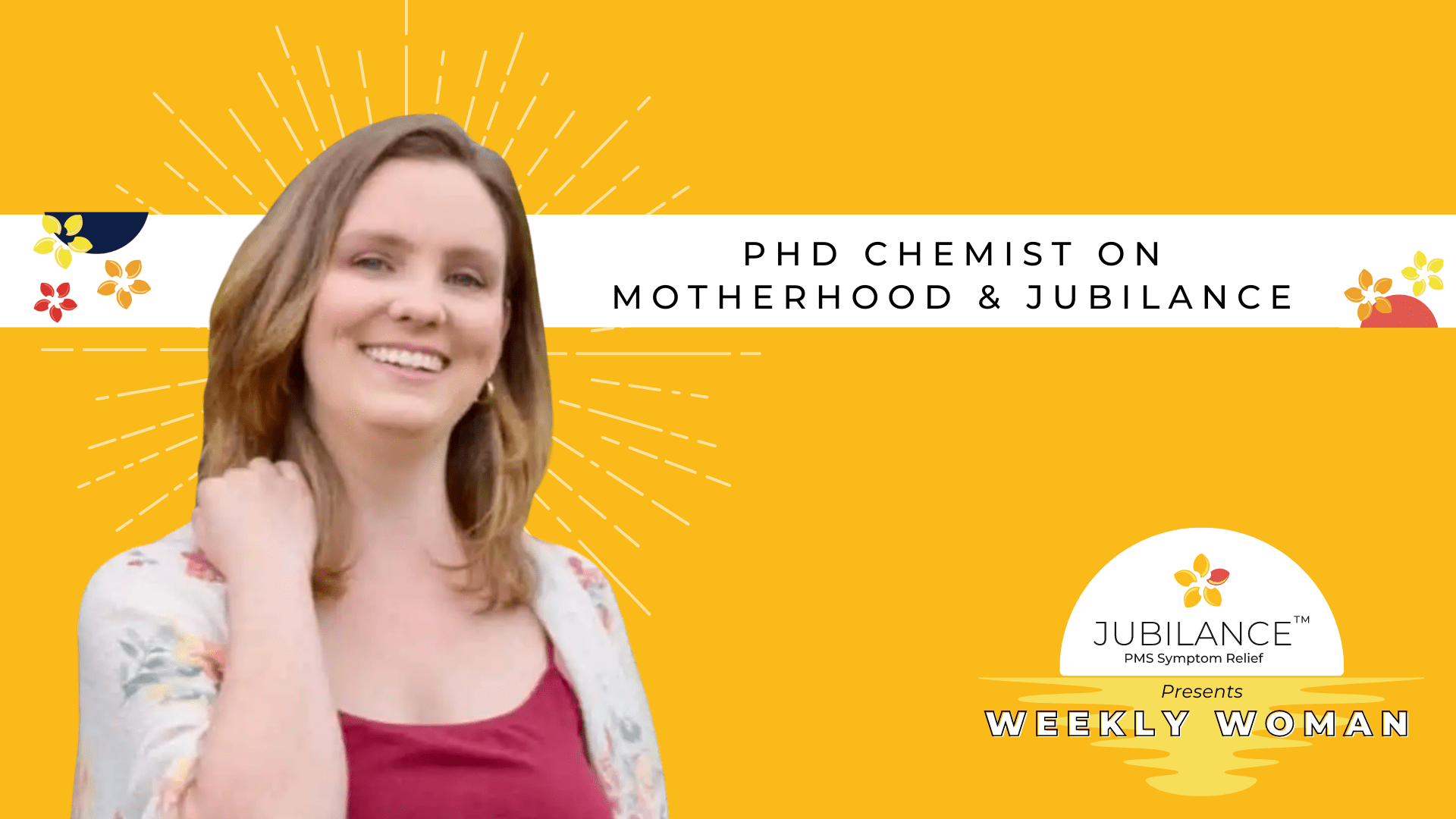
Chemist and Public Health Expert Samantha Radford wants to change the way we learn about information. As an expert in toxicology, she focused years of research into learning about how chemical exposures affect both unborn babies and children, as well as how toxicants and medications are passed through breastmilk.
She started her blog Evidence Based Mommy to educate other mothers on this toxicology focused background. But not only does she talk about chemistry, she also goes into how she raises her four children.
And moms get anxious too, so her story goes further into finding therapy, and eventually trying out Jubilance for PMS. We’re so happy to have her on the podcast, let us know what you think! And be sure to visit her blog Evidence Based Mommy to find out more!
Watch her Interview:
Listen to her Interview:
Read her Interview:
Alice: Great, we’re recording. Cool. Well, thank you so much, Samantha. It’s so exciting to have you on the podcast.
Samantha: Thank you so much. I’m so excited to be here.
Alice: Yeah. I was just wondering too, where are you calling in from?
Samantha: So, I have been in Pennsylvania since 2014. Originally, I’m from Georgia. If you hear a little twang, that’s where it comes from. But I’ve been in Pennsylvania for a while now.
Alice: Oh, amazing. Yeah, I love your accent. I was just thinking, “Oh, it’s so lovely.”
Samantha: Thank you.
Alice: I just have the California surfer-bro accent, but you can kind of hear. But where in Pennsylvania are you?
Samantha: Central, about an hour from State College.
Alice: Oh, cool, convenient. Yeah, that’s a great location, can go anywhere from Pennsylvania.
Samantha: Yeah, so can go to Pittsburgh or to Philly. Philly it’s not too far, Pittsburgh’s closer but…
Alice: Okay. Oh, cool. And can you talk a little bit about what you’ve been up to in the pandemic? So, luckily, you’re in Suburbia, and little more isolated.
Samantha: Yeah. Honestly, everything worked out so well for me. So, I had started my blog Evidence-based Mommy, which I’m sure we’ll talk about some, back in 2018 and I ended up leaving. We’ll talk about this too, but I ended up leaving teaching chemistry, full-time at a local College. It turned out that my last semester was fall of 2019. I was so grateful. So, I got done with that, my fourth child was born on January 3rd. So, I was on maternity leave. Technically, that was my last semester, but I was on maternity leave, so I wasn’t there. And then everything happened, so I was hearing about colleagues who are having suddenly figure out how to do all their classes on Zoom. How they’re teaching labs[?], which is so hands-on, I guess in the kitchen, I mean, I don’t know, I didn’t…
Alice: Oh my gosh. I can’t even imagine.
Samantha: Right. And you know, my husband, of course, he wasn’t going to work anymore because the shutdown was just everything. So, it was kind of like we were given a month of parental leave for him. It was just beautiful. And then the next year, when things are still pretty intense with all that, I just homeschooled my two daughters. So, second grade and kindergarten for homeschool, they’re back to school now.
Alice: Oh good.
Samantha: But it worked out so well for me. And then, I’ve been able to build one business during this time. Yeah.
Alice: Yeah, that’s amazing. That’s so great that you were able to be with your four children, which is so lovely, and your husband got to be around a lot more. I think that’s something that my parents really loved. I mean, I’m in my 30s, but everyone came home for a little bit. I have two other sisters and my parents were like, “When are we going to get this time ever again?”
Samantha: Right. Yeah. It was lovely.
Alice: So, that was a special part. But other than that, I’m in New York right now. So, it was a little crazy. But…
Samantha: Oh, yeah, I can imagine.
Alice: Yeah, but I can’t imagine like chemistry in the kitchen or the lab part.
Samantha: Vinegar, baking soda, you can make that kind of thing work. Again, I didn’t have to.
Alice: Yeah. Thank goodness. Yeah, that’s amazing. And you mentioned Evidence-based Mommy. Can you talk a little bit about what that is?
Samantha: Yes, so I was talking to a friend, like I said, I started back in 2018. Actually, my yoga teacher, I was talking to her, I was like, “I would love to be able to build a website like to help moms, to take all this kind of science stuff that I’ve learned,” because I’m an environmental chemist, but specifically, the what kinds of chemicals are toxic to humans; how are we exposed to them? Especially, how does it affect maternal health? How does it affect the health of the child, both before they’re born, and postnatal? So, I would love to get this information out in a digestible way to the people who actually need it. And so I was like, “I think I’m going to start this,” and she’s like, “You should.” So, here we are.
Alice: Yeah. Wow, that’s amazing. I think that is really helpful, especially, I was looking at your website and it’s about weeding out all of the information that we’re given. There’s so much on the internet of like, this will be bad, this will be bad, and so much conflicting information. But to have you as a chemist telling us, what is in this toy? What is in this play couch? What should we be using? What shouldn’t we? I think it’s so useful and helpful.
Samantha: Thank you. Yeah, because I mean, that’s exactly it, that you’ve got one side and there’s a lot of lobbies and industry, all that. That’s just like, “Oh it’s all fine,” and they’re not want to tell you anything. And then, you’ve got people who probably don’t have the background necessarily, but if they hear a big word that they can’t pronounce immediately, they freak out and figure, it must be bad. And so you’ve got these two extremes that neither of them are really founded in the actual information that we have at the time. And so, I’m trying to give a more nuanced view, but also you don’t have to have a degree in chemistry to understand what I’m saying. That’s my goal.
Alice: Yeah. It all was very digestible, easy to read as someone in marketing and the arts.
Samantha: Oh, thanks. That’s the goal. That’s exactly what I want.
Alice: Yeah, that’s amazing. So, you started this in 2018, after it been percolating in your brain. Can you talk a little bit more about starting a website and building it up from there and being like a woman with your own business?
Samantha: It’s funny because I tell people I pretty much just Googled how to start a blog and I did. And that’s not what I recommend. There’s so many great people, just like we were talking about with good information and bad information with science, there’s a whole lot of really great reputable people who’ve been blogging for 15 years and they really know all the ins and outs. And there’s some that have had a blog for about six months, and made a little bit of money, and have decided that they can teach you how to blog now. So, you’ve got to watch out for that. I feel like I got fortunate, I found a lot of good sources. But, yeah, it’s a whole new skill set. So, the actual writing, we were talking about this post, that’s actually one of the smallest parts of what I do because there’s so much other background. Things that you wouldn’t even think of, like graphics that you create or creating courses or the podcast like this outreach. There’s so much and there’s so much to learn, but I love it.
Alice: That’s amazing. Because I imagine you’re doing SEO and you’re trying to market it to get people to see it too. So, just the writing is, like you said, such a small portion, but so important and what we want to read.
Samantha: Thank you. Yeah, I mean, you mentioned that marketing degree, you always hear people talk about like, “Oh, you should take business classes in college,” and of course, I was just like, “Whatever,” and now I’m like, “Gosh, I wish I had some business.” Because I mean, the business I know, I’ve learned in the past three and a half years, and here we are.
Alice: Oh my gosh. I am the same way. So, actually, I studied art history and theater and those are not what I’m using anymore at all. But I’ve just been taking classes over the past couple of years in finance and marketing, and now I work in marketing, but wouldn’t that have been good?
Samantha: Right. Yes. But, at the same time, it’s okay to– even if your degree, they say isn’t relevant or whatever. Because what I’ve found, especially when I was still in academia and talking to professors and whatnot, we all have our own framework about how we see the world, and it’s really influenced by the education path we choose. And so, you can talk to a historian about the same subject as you’re talking, to a religion major about it, and they come at it in such a different way. And then you put a chemist in there, and those were the most fun conversations to me, was to talk to all a bunch of different disciplines at once and see how they view things.
Alice: Yeah, that’s so interesting. And I imagine with chemistry, you have such a different ideology of just how to approach a blog, chemists aren’t writing blogs necessarily or writing blogs about this. I’m very curious, how did you bring both your chemistry and your background in higher education? How do they go into this Evidence-based Mommy?
Samantha: I mean, I enjoyed the teaching side. So, like I said, I taught at a small school where the biggest class I had was probably 25 or something. So, I really got a lot of interaction with the students, got to know them. And one of my favorite things when I started teaching more upper-level, like three hundred level classes, was to focus on their writing. Really helping them bridge, because a lot of times as a writer, we forget that what is in our head, is not what is in our audience’s head and you make this jump in logic that you don’t build-out. And so, teaching students, you need this transition here. How does this sentence correlate to this next idea? And so, I love doing that, and I’ve really had to hone those skills, writing, and doing the blogging, and the way that I write for this is very different from how I would write for school, for writing a grant, or for filling out report or whatever. Even like you said with the SEO, chopping things up into smaller paragraphs so that you don’t have a huge wall of text on your phone if you get bored with, it’s interesting, again, always learning.
Alice: Yeah, and you’re certainly creating this sort of writing that’s more accessible to the everyday reader. It’s not a paper that you’re putting in a journal now. But the language is all there, and you’re breaking down those hard terms that we might just turn away from in terror, but so we’re able to understand what’s happening.
Samantha: And I still try to ask, especially if I’m doing something that’s, “more science.” I still try to go back to the literature and actually lookup. So, I’ve got an article about, “Is it safe to use while you’re breastfeeding?”. And so, I went back and I mean, that’s what I did was analytical chemistry. How much of this chemical gets into this thing? How much of this gets into breast milk? Once it goes through the mother’s whole system and all that. So, I was able to look up and these people were using HPLC, which is a method to measure something and breast milk, like the same kind of thing that I was using when I was in grad school. I can actually read that and digest it like you said, and then put it out there like, “Yes, this really is safe because there’s such low levels.” But I still linked to that in case someone feels wild and crazy and wants to read.
Alice: Oh, that’s so interesting. And so helpful to have someone that can give the general public the evidence, and it’s the ones that they need.
Samantha: Thank you.
Alice: And I think something that I found that I like really took away from your website and your blog was, manage your emotions, so you could manage everything else.
Samantha: Yes. Yeah. I’m actually working right now to create a program all around that because anybody who’s done any academia, there’s a lot of hoops to jump, there’s a lot of different roles to fill, it’s not just teaching those classes and coming back. I’m sure just like teaching elementary school or high school, there’s a lot more to it than being in the classroom. And so, when I first started teaching up here in Pennsylvania, we moved up here is basically just me and my husband and my toddler and then I’ve got pregnant. So, that second year, It was me and my husband, my toddler and a newborn, and basically still new at teaching. And I remember telling someone, that is like, you remember how sometimes in elementary school, you might have had a pencil that was sharpened all the way up to where it was basically just the nub of the pencil and the eraser, and that was it. That’s how I felt, I was just so depleted, and just so stressed and started going to therapy, started kind of figuring this out, getting tools to help, and actually, my in-laws moved up. So, my husband and I, we’re both only children. So, his parents just came up, they couldn’t stand being away from the kids.
Alice: Oh, awesome.
Samantha: And, yes. It’s been such a huge help. But anyway, I started figuring out, that being able to take a step back and think, even though my toddler is hanging onto my leg, screaming, while I’m trying to cook dinner and the bigger kids begging me to watch her do yet another cartwheel. And you just like, that it’s going to be okay, none of those things are emergencies, the house isn’t on fire. And that’s so hard to do, especially in the moment. But if you can start being, “Is this an emergency?” “No, no, it’s not.”
Alice: I love that you were finding not only ways to look at children’s toys and look at the chemistry behind that, look at like breastfeeding, but also your blog is also about managing mom’s emotional health. Which I think is so important, which is what you’re talking about.
Samantha: Right. And there’s a lot of literature out there, there ought to be more, but there’s a lot out there, too. So, again, if I can, even though that wasn’t my field, I can still go back to psychology journals and behavioral development journals and that kind of thing and actually look and see, what’s the latest in that.
Alice: Yeah. And…
Samantha: So, I love sharing that.
Alice: Oh great. Yeah, and I mean, that’s what my company is all about too. Jubilance for PMS, which is trying to help women with the emotional side during that time of the month.
Samantha: Yeah. It’s such a great combination again of science and emotional health.
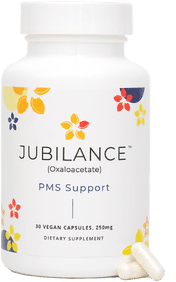
Alice: And you’ve been trying Jubilance. Can you talk a little bit about that? Do you feel like you have enough of a study behind you?
Samantha: Yeah. So, I’ve got almost two months in. I will say the first month I only, so, before I’d gotten to a point in my life where it feels like half of my month is consumed by PMS. I felt like from ovulation to a day or two after I started, I was just, it’s a lot, that’s too much.
Alice: That’s way too much PMS.
Samantha: It is way too much PMS, especially when you do have four children and a business and the whole thing. The first month, I only had one day where I felt super duper high strung and it happened to be the day that my cycle started. But also, my husband and I were going out of town. So, we were packing and trying to get the kids together and there was a lot going on. So, I’m like, “That’s legit to be stressed about.”
Alice: Yeah. That makes sense.
Samantha: And I feel like it’s been shorter this month, too. So, it’s only been a couple of days instead of the whole thing. So, I’m looking forward to getting another couple of month under my belt, but yeah.
Alice: Oh my gosh. Fingers crossed that you feel so much better with Jubilance.
Samantha: Yes
Alice: Yeah. So, I think oxaloacetate, too, which is the main ingredient in it is also a scary word that turns people off immediately. It’s like, “Oh! What is that? Is that oxalate?”. Like, “No, definitely not. It’s part of the Krebs cycle.”
Samantha: Yeah. I was like, “Oh man, I had to learn the Krebs cycle back in my junior year of college.” I was like, “I remember this cycle.” That was not my favorite part. So, I’m glad it was somebody else’s favorite part.
Alice: Yeah, exactly, I know. So long ago, I feel like you just mention it and it’s like, “Oh, yeah, I remember that from the past, high school.” So many years ago.
Samantha: It’s funny, I was talking to someone and telling them about it and I had to look it up and spell it out. And she’s like, “That’s too many bells. That just makes me angry to look at.”
Alice: I know, but it actually does work.
Samantha: Right. Yeah.
Alice: It is helpful oxaloacetate.
Samantha: Yeah, it was a really fascinating idea to think, it’s brain chemistry and not necessarily just hormones and some stuff like, “Oh, that’s really cool.”
Alice: Yeah. It really helped me. So, as a small family business, and having the worst PMS ever in college, I started taking it slowly, I felt more normal. My brain was sort of more regulated. Yeah. So, we’ll see what happens with you. I’m excited to hear about more of your journey.
Samantha: Yeah, yeah. I really am excited to see how it goes.
Alice: Awesome. Yeah, and then I’m just curious, what is next for Evidence-based Mommy?
Samantha: So much. Like I said here, in just the next couple weeks, and I can give you a link to the waitlist if you want, but I am launching a program actually to help parents, still a little up in the air about the name, I thought about, “From Reactive to Responsive, I’ve thought about, “Feelings Tamers for Moms.” But basically, an eight-week program to really help you delve into, how to reprogram those tapes in your head that as soon as you have an emotional outburst where you’re like, “Why did you do that?” Because that’s not helpful. So, they help you be able instead to say, “I messed up this time, but I can do better next time.” And really form a community with other moms during that same stage of life to kind of help with that.
Alice: Oh, that’s awesome.
Samantha: Yeah.
Alice: Is that going to be virtual or in-person?
Samantha: It’s going to be online. So, everything is online [inaudible].
Alice: Oh, cool.
Samantha: Yeah. So, I’m hoping people from all over the world. So, I know there’s already people all over the world like Evidence-based Mommy, so. And then my other big thing is my annual Breastfeeding Beyond Babyhood summit. So, that’s going to be in July, and the idea with that is basically there’s, and there should be, but there’s so much support out there for those first few weeks of breastfeeding. When you’re first trying to figure out latch and is there a tongue tie and is my supply okay and all that, which we need for sure. But then once you get to the point where your child is closer to urine age, people either assume like, “Oh, well, aren’t you supposed to wean by now?”, which isn’t the case. The World Health Organization recommends breastfeeding for at least two years and then as long as both mother and child want.
Alice: Wow.
Samantha: Yeah. So the American Academy of Pediatrics says, at least a year. World Health Organization says, at least two years.
Alice: Wow.
Samantha: So, yeah. And the biological norm based on a lot of different anthropological evidence is six or seven years for breastfeeding.
Alice: Wow, that’s amazing.
Samantha: Right. And I mean, there’s lots of other places in the world where that seems totally normal. But here in the United States were like, “That’s weird.” Because the whole industry, we could get into a whole thing about all of that, not supporting–
Alice: Oh. Interesting, yeah.
Samantha: Yeah, it’s a whole thing but I won’t. Anyways, so the point is, once you get to that first year, people either assume you’re supposed to wean, or they assume they like, “Oh, you’ve got it all figured out by now, you’re good to go.” But there’s actually a lot of things that can crop up. So, for example, something called nursing aversion, which I would be curious honestly about Jubilance if it could help with that because it’s kind of a skin-crawling, “Oh, don’t touch me,” sort of feeling. And it’s very difficult and frustrating because you as a parent, mentally, you know breastfeeding is good for them and you want to want to, you know what I mean?
Alice: Yeah.
Samantha: But you have this, just don’t touch me, very touched out thing and that causes a lot of stress for moms. I had to wean my youngest prematurely because of that. Oh, not my youngest, my oldest.
Alice: Wow.
Samantha: So, that’s something, or perhaps people were concerned, “If I get pregnant, can I still breastfeed?”, which you totally can, “Could I breastfeed a newborn or toddler both the same time?”, which you can. But all these things that don’t necessarily get talked about or even really I just want to wean this kid, and I don’t know how. Because we need to support people at the end of their breastfeeding journey too, and a lot of times there’s so much push to just keep breastfeeding them forever that people don’t know how to end that journey.
Alice: Oh. Interesting.
Samantha: So, I want to be able to– moms have mostly toddlers, maybe some preschoolers, wherever they are in that journey with breastfeeding, to be able to support them. So, that’s what…
Alice: Oh, cool. So, that’s what your summit is.
Samantha: Yeah, yeah.
Alice: Really allowing that space for that. Okay. Interesting, I don’t know anything about that. I do not have children yet, but it’ll be really interesting to learn about that when I do and certainly a lot of my friends are having them now. So, yeah, that’s so interesting. I had no idea that it wasn’t supposed to be or it’s supposed to be over a year. I had no idea.
Samantha: Yeah, exactly. Yeah, there’s still tons of benefits, both immune system support so your body produces, if your child is sick, they pass some of the germs to you through nursing, and then your body produces antibodies that get passed back to the baby. And then, it’s so helpful, like if your child is sick and maybe a sore throat and refuses to eat and all they’ll do is nurse, you know that they’re getting nutrition and hydration and all that. Even they’ve done studies where little boys who nurse longer, later, have better social and emotional development when they’re older. So, yeah.
Alice: That’s so interesting. Yeah, I just know nothing about this but fascinating.
Samantha: Yeah, I could go forever, but I won’t.
Alice: Yeah. Wow. Yeah, and then something that I always ask on this podcast is what is your definition of womanhood?
Samantha: Oh, gosh. I wish [inaudible] think about that before. Wow. “What is Womanhood?”
Alice: I think it’s something that changes like second to second a person’s day. My definition is constantly shifting, but at the present moment, what is it?
Samantha: I mean, I think that we need to have solidarity with each other and be able to help each other and lift each other up with all the different things that we’re facing now in the world. I think being, like you said, to hold space for each other no matter where we are on our journey, being able to help each other.
Alice: I think that’s lovely. I mean, that’s what you’re doing with Evidence-based Mommy. You’re creating this safe space for women to talk and have dialogue and to learn more in a real way and know that this evidence is real, which is so cool.
Samantha: I appreciate that.
Alice: Yeah. And how can people find out more about Evidence-based Mommy and where should they go to see what you’re up to?
Samantha: So, of course, you can just go straight to the website, evidencebasedmommy.com. You could also find me on Instagram, so that’s @evidence_basedmommy. And those are probably the best two places to find me.
Alice: Oh my God. Amazing, Samantha. Thank you so much for being on today.
Samantha: Thank you so much.
If you liked this article, check out the rest of our interviews on our podcast Weekly Woman.
And if you need a little pick me up from the stresses and anxieties of PMS, try our OAA Supplement (oxaloacetate), that can help with the gloominess, irritabilities, anxieties, and stresses of that time of the month.